Table of contents
What is chrome plating of parts?
Chromation of parts is a surface coating process in which a thin layer of chrome is deposited on a metallic component, generally by means of electrodeposition. Its main objective is to improve resistance to corrosion and wear, while providing a glossy, satin or even matte aesthetic finish, depending on the needs of the project.
There are two main categories of chrome:
-
Decorative chrome → is applied in very thin thicknesses (usually between 0.2 and 0.5 microns on a nickel base) and is used above all in automotive, faucets and decorative items, where aesthetics are important.
-
Hard chrome → is applied in much larger thicknesses (from several microns to tens), designed for technical applications where maximum resistance to wear and friction is required, such as machinery or industrial molds.
Thanks to its versatility, chrome can be adapted to both small and complex parts and large components, always guaranteeing a uniform and high-quality finish.
Step-by-step chrome plating process
Chromation of parts is carried out in 6 phases: preparation, polishing/degreasing, activation, intermediate layers (Ni/Cu), chrome deposit and final control.
- Preparation and cleaning → removal of grease, dust and oxides by means of alkaline or ultrasonic cleaning to guarantee the adhesion of the coating.
- Fine polishing and degreasing → the surface is smoothed with mechanical or vibratory polishing and electrolytic degreasing is carried out to obtain a uniform finish.
- Surface activation → pickling or mild acid activation that removes passive residues and leaves the piece ready to receive the metal layers.
- Intermediate layers (nickel/copper) → application of nickel (and, in some cases, copper) as an anti-corrosion barrier and leveling base prior to chrome.
- Chrome deposition → electrodeposition in a chrome bath (Cr III or Cr VI) controlling current, time and temperature to achieve a glossy or satin finish.
- Rinse, dry and inspect → cascade rinses, dry without marks and thickness/finish control; corrosion tests such as salt spray are added to technical parts.
Advantages of chrome in the industry
The chrome plating of parts is not only used for its aesthetics, it also provides technical benefits that make it one of the most demanded finishes in sectors such as automotive, locksmithing, taps and electronics. Among its main advantages stand out:
- Corrosion resistance → the chrome layer acts as a barrier against moisture, chemical agents and demanding environments.
- Durability and extended useful life → protects the pieces against mechanical wear and constant friction.
- Premium aesthetics → allows to obtain glossy, satin or matte finishes, improving the perception of the final product.
- Easy cleaning and maintenance → the chrome surfaces are smooth, hygienic and easy to keep in good condition.
- Versatility of applications → adapts to multiple sectors, from decorative uses to high-performance technical components.
- Added value to the product → increases competitiveness in the market by combining functionality with an attractive appearance.
Applications of chrome plating
Chromation of metal parts is used in numerous industrial sectors thanks to its ability to combine resistance, durability and aesthetics. Its most common applications are:
- Automotive → in handles, trims, rims, grilles and mouldings, providing protection against corrosion and a high-quality glossy finish.
- Faucets and sanitary ware → in taps, showers and bathroom or kitchen accessories, where the chrome ensures resistance to humidity and easy cleaning.
- Locksmithing and hardware → in locks, hinges and mechanisms, improving durability against wear and offering a professional appearance.
- Electronics and housings → in connectors and external parts, where a uniform and aesthetic finish is required along with certain conductivity.
- Decoration and furniture → in mirror frames, lamps, handles and design elements, thanks to the premium aesthetics provided by the chrome finish.
- Machinery and technical applications → in components subjected to wear, where hard chrome plating increases useful life and performance.
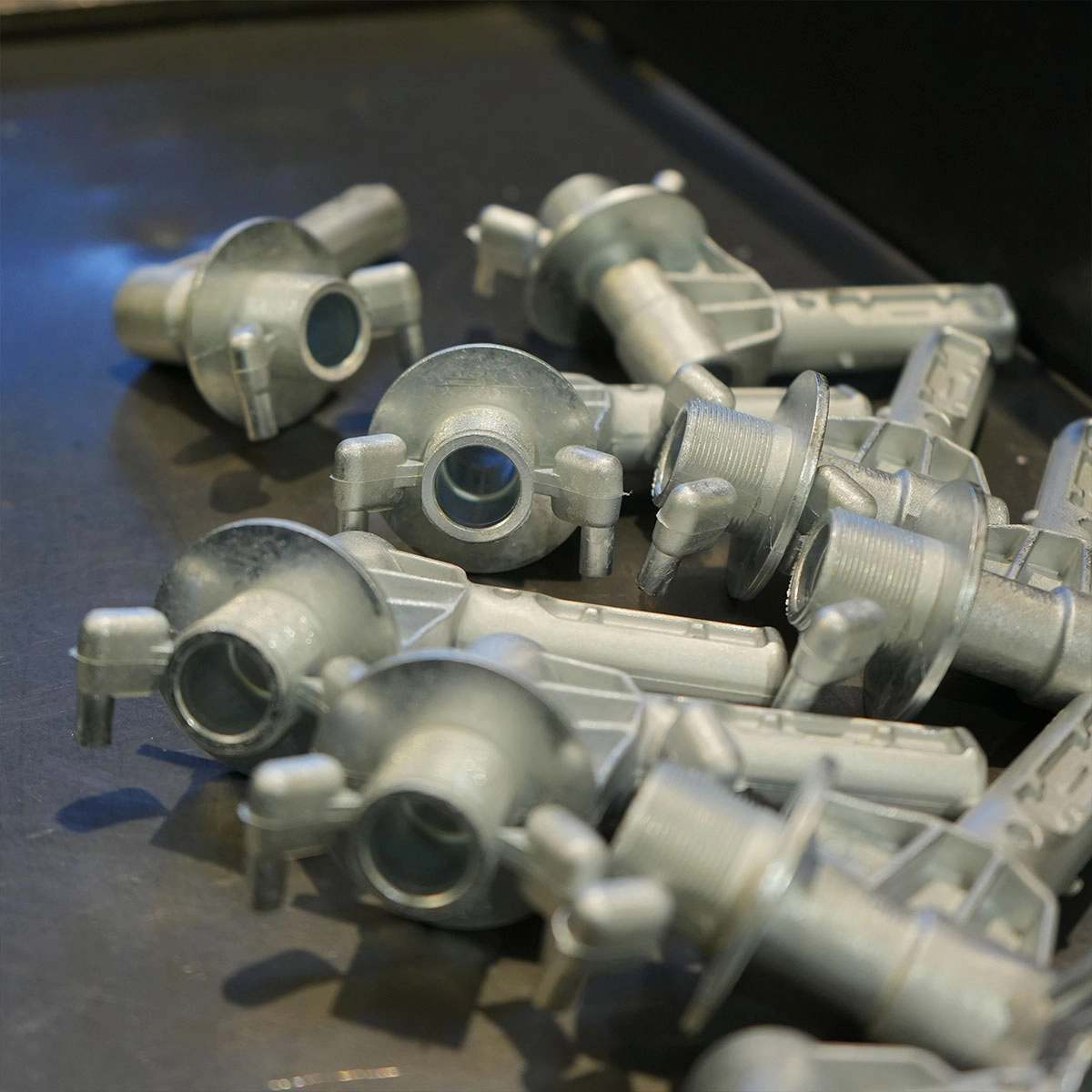
Chrome plating of zamak parts
Zamak is an alloy widely used in sectors such as automotive, locksmithing, taps and electronics due to its precision in molding and its good cost-durability ratio. One of the most common ways to improve its performance is by chrome-plating zamak pieces, a treatment that provides:
- High-quality aesthetic finishes → glossy, satin or matte surfaces, adapted to each application.
- Corrosion protection → the nickel and chrome layer acts as a protective barrier against moisture and wear.
- Uniformity even in complex pieces → zamak allows obtaining regular coatings in difficult geometries.
- Added value to the final product → increases durability and the perception of quality in sectors where aesthetics are key.
Frequently Asked Questions (FAQs)
What advantages does the chroming of pieces offer in the industry?
Chrome improves corrosion resistance, prolongs the useful life of the parts and provides a shiny, satin or matte aesthetic finish. This makes it a treatment widely used in automotive, plumbing, locksmithing and other industrial sectors.
What is the difference between decorative chrome and hard chrome?
Chrome improves corrosion resistance, prolongs the useful life of the parts and provides a shiny, satin or matte aesthetic finish. This makes it a treatment widely used in automotive, plumbing, locksmithing and other industrial sectors.
Can zamak pieces be chromed?
Yes. Zamak is an ideal material for chrome because it allows uniform coatings to be obtained even on complex pieces. The result is a brilliant, resistant and high-quality finish that is in demand in the automotive, locksmith and faucet industries.
How do you check the quality of the chrome?
In addition to the visual and thickness inspection, the quality of the chrome can be evaluated through accelerated corrosion tests such as the salt spray chamber, which measures the coating’s resistance to aggressive environments.