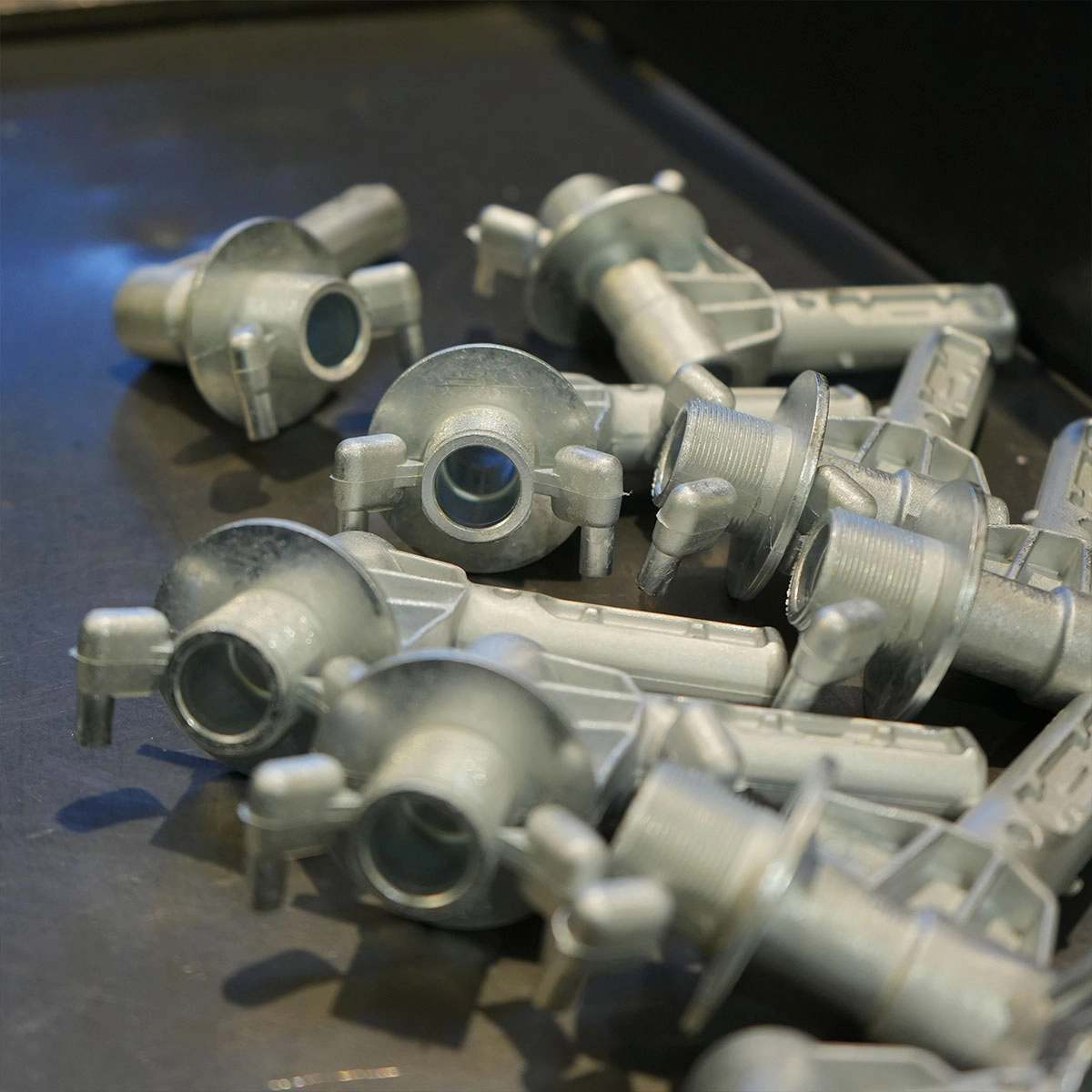
Die casting is one of the most widely used processes in the manufacture of precision metal parts. It consists of injecting molten metal at high pressure into a custom-designed steel mold for each project, resulting in complex parts with high repeatability.
At Funmak, we primarily use this process with zamak, although the technique can also be used with other non-ferrous alloys. If you’d like to discover how it works and what advantages it offers, keep reading.
What is die casting?
Die casting is a manufacturing process for metal parts in which molten metal is pressed into steel molds. These molds are designed for each project, ensuring that every component is created with precision and repeatability.
What is die casting used for?
The benefits of using the injection molding model include advantages such as cost savings and a reduction in the total cost of production.
Casting a part allows for the production of complex shapes, such as threads and intricate geometries. Furthermore, it is possible to combine multiple metal parts into one, eliminating assembly steps and reducing labor costs.
How the process works
There is no single method of injection casting: there are two main processes, depending on the characteristics of the material and the part.
Hot chamber
This is a great option for alloys that do not easily attack or erode metal crucibles, cylinders, and plungers. At Funmak, we primarily work with this method.
Cold chamber
This is usually the most recommended method for working with high melting points. The metal is liquefied and then poured into a cold chamber, where a hydraulically driven piston pushes it into the mold.
Benefits and alloys of die casting
Injection casting can mean significant savings in manufacturing costs. By casting metal parts, virtually any type of shape can be created, and it is possible to combine multiple components into one, eliminating assembly and reducing labor.
Other benefits of the process: variable wall thickness, tighter tolerances, fewer production stages, fast cycle times, reduced waste material, and long-lasting tooling.
The alloys used in die casting are non-ferrous metals, completely recyclable, with high strength and hardness, good thermal and electrical conductivity, and excellent surface finishes.
The process at Funmak
At Funmak, we primarily work with zamak. Thanks to its high fluidity, the material is forced into the mold under high pressure, completely filling the cavity and allowing it to reach every corner of the design.
Each machine has a crucible where the base material, in ingot form, is introduced and melted at a temperature of 380-390 °C. Once melted, it is injected into the mold; after that, the parts are separated—automatically or manually—from the feeding channels.
We have extensive experience in die casting, offering high-quality zamak parts for multiple industrial sectors.
Request your quote with no obligation
Call or write to us and connect with our team of zamak casting and injection specialists.
We’ll analyze your idea and propose the best, customized solution, with no obligation.